PD, Probability of Default
Through-the-cycle PDs are built from multi-year rating migration matrices, then converted to point-in-time and projected under each macro scenario using a documented regression.
Nizor 9 is Finspera 21's IFRS 9 ECL platform, one auditable system for staging and SICR, PD / LGD / EAD modelling, forward-looking macroeconomic scenarios, provision movement and regulatory reporting. Built by practitioners for banks, NBFIs and finance teams that need impairment numbers they can defend.
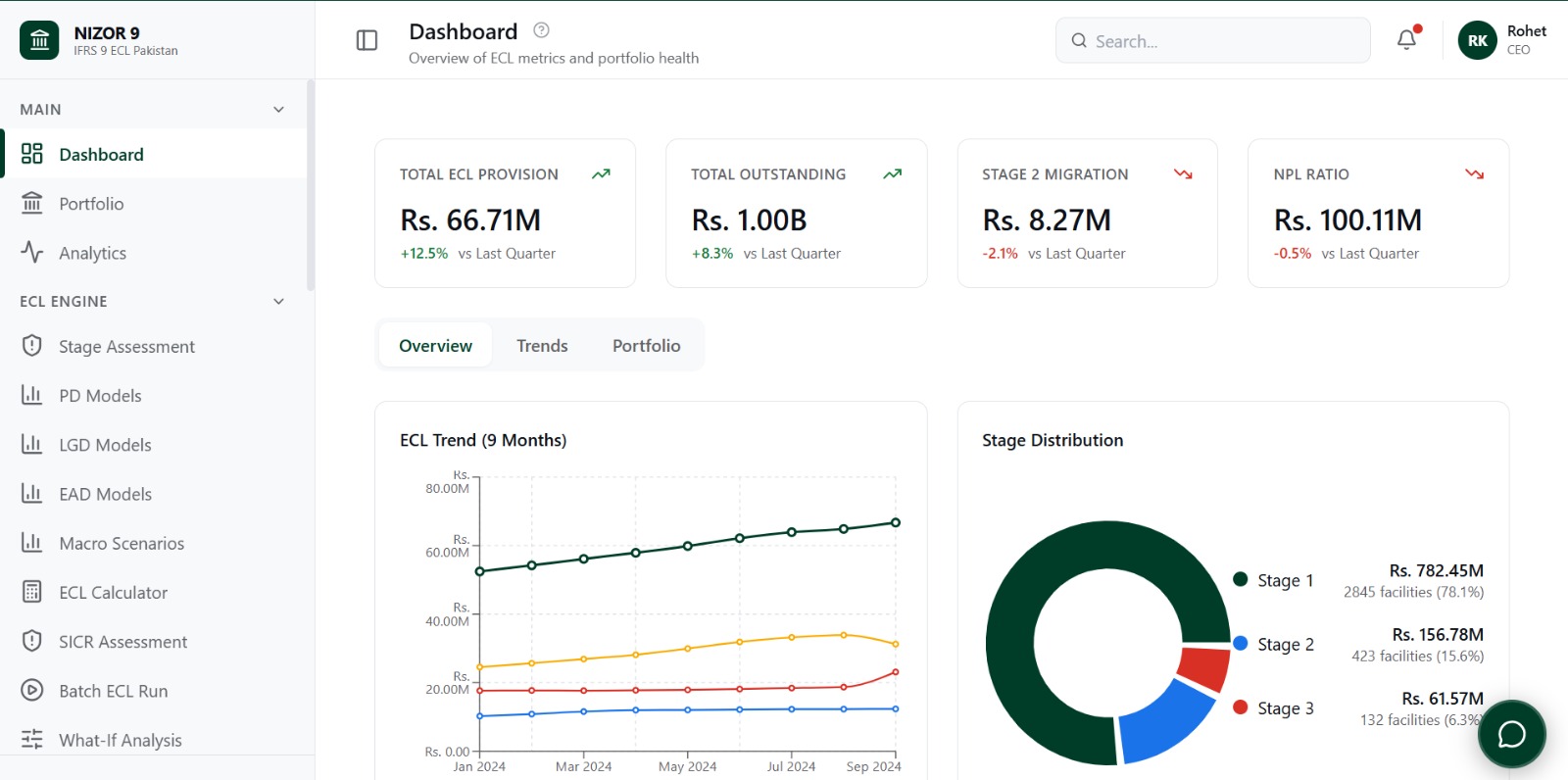
IFRS 9 replaced the incurred-loss model of IAS 39 with a forward-looking expected credit loss model. Every financial asset measured at amortised cost or FVOCI carries a loss allowance, recognised from day one, updated every reporting date, and reflecting reasonable and supportable forward-looking information. For most lenders, that means probability-weighted estimates of default across an entire portfolio, refreshed each quarter.
Spreadsheets do not scale to that. They break under version control, resist audit, and hide the judgement behind the number. Nizor 9 is the system of record for your ECL: it holds the portfolio, applies the staging rules, runs the PD / LGD / EAD models, weights the macroeconomic scenarios, and produces the provision, the movement and the disclosures, with every input, assumption and run captured for your auditors and regulator.
Nizor 9 runs the full IFRS 9 chain for every facility, every reporting date, with each step logged and reproducible.
Load the loan book by template or API. Data quality checks flag missing fields, stale valuations and outliers before anything runs.
Each exposure is placed in Stage 1, 2 or 3 using DPD backstops, rating migration and qualitative triggers.
Point-in-time PD, collateral-based LGD and EAD (including undrawn CCF) are computed per facility.
Base, optimistic and pessimistic macro paths are probability-weighted into a single expected loss.
ECL is aggregated, the movement is reconciled, and journals, notes and regulatory returns are generated.
Computed over a 12-month horizon for Stage 1 and over the lifetime of the exposure for Stages 2 and 3, then probability-weighted across macroeconomic scenarios and adjusted for any documented management overlay.
The portfolio is the heart of the platform. Each facility carries its stage, outstanding, EAD, 12-month PD, LGD, ECL and days-past-due, filterable by segment, portfolio and stage, and exportable for review. Staging is applied consistently and transparently, so an auditor can trace any allowance back to the exposure that produced it.
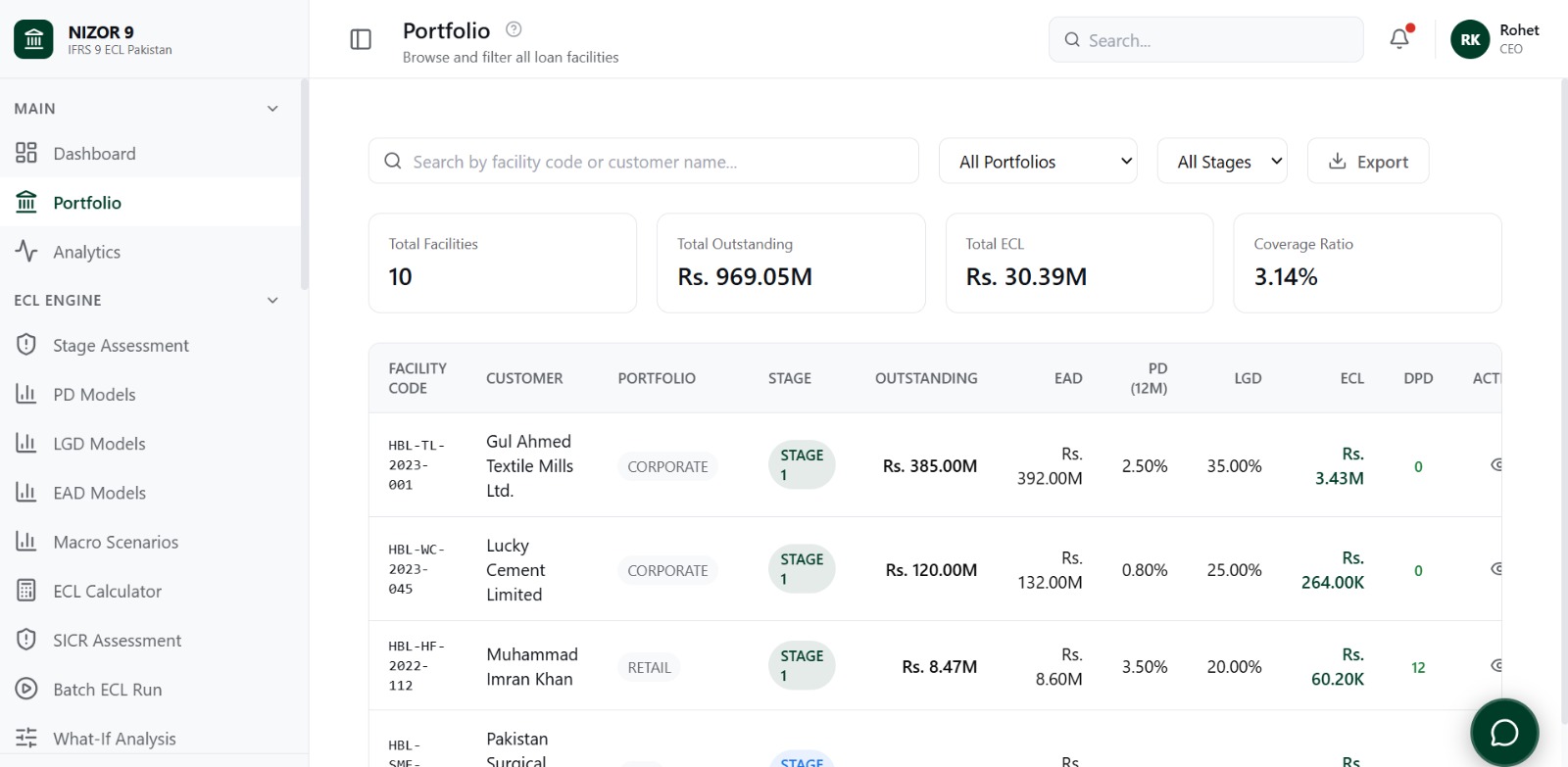
Automated stage allocation with SICR detection.
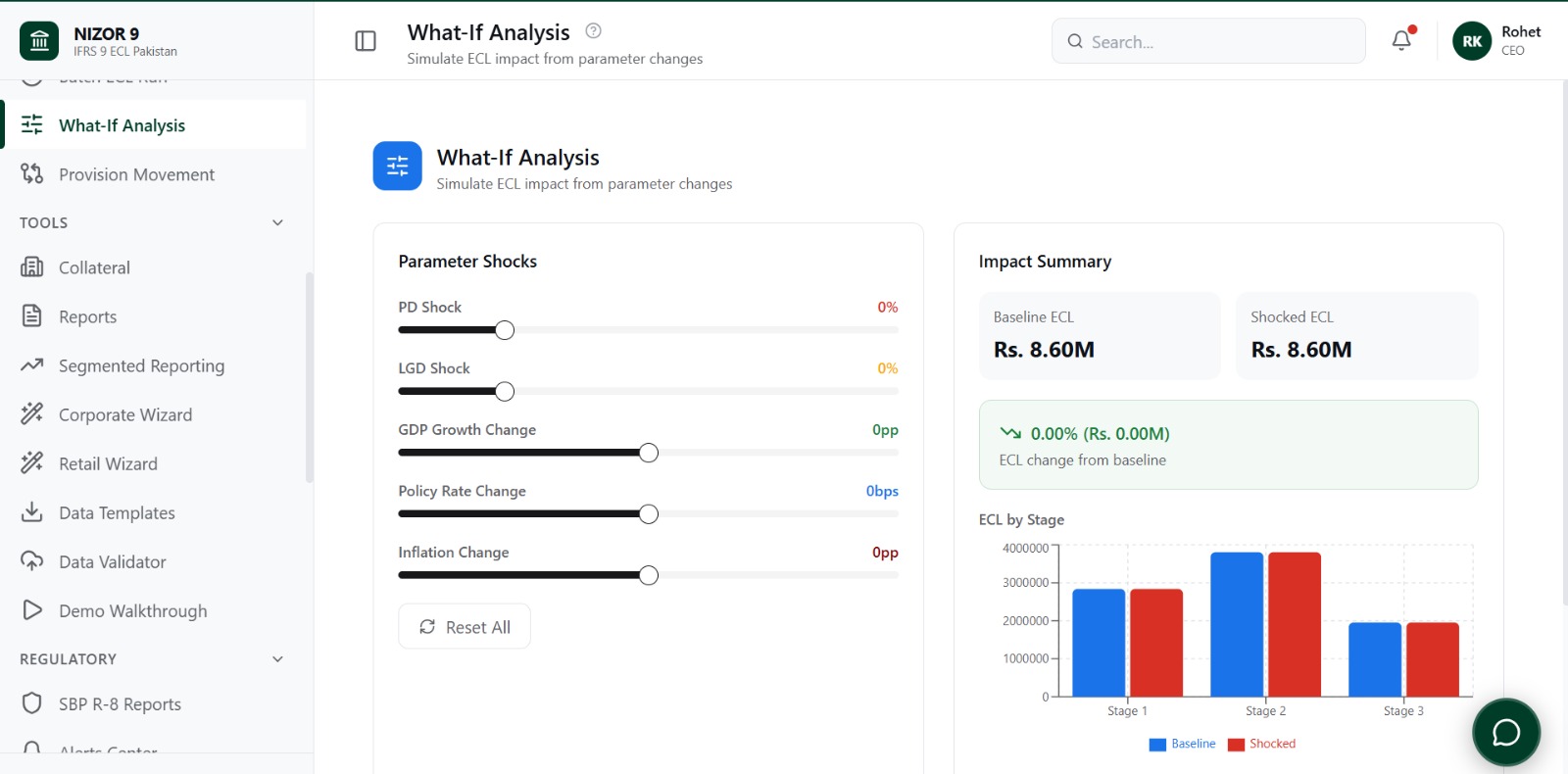
IFRS 9 requires reasonable and supportable forward-looking information. Nizor 9 links your point-in-time PDs to macroeconomic variables, GDP, inflation, the policy rate, KIBOR, exchange rate, and weights base, optimistic and pessimistic scenarios into the allowance. The what-if console lets you shock any driver and see the ECL impact by stage before you commit, so sensitivity analysis for the audit committee is a slider, not a rebuild.
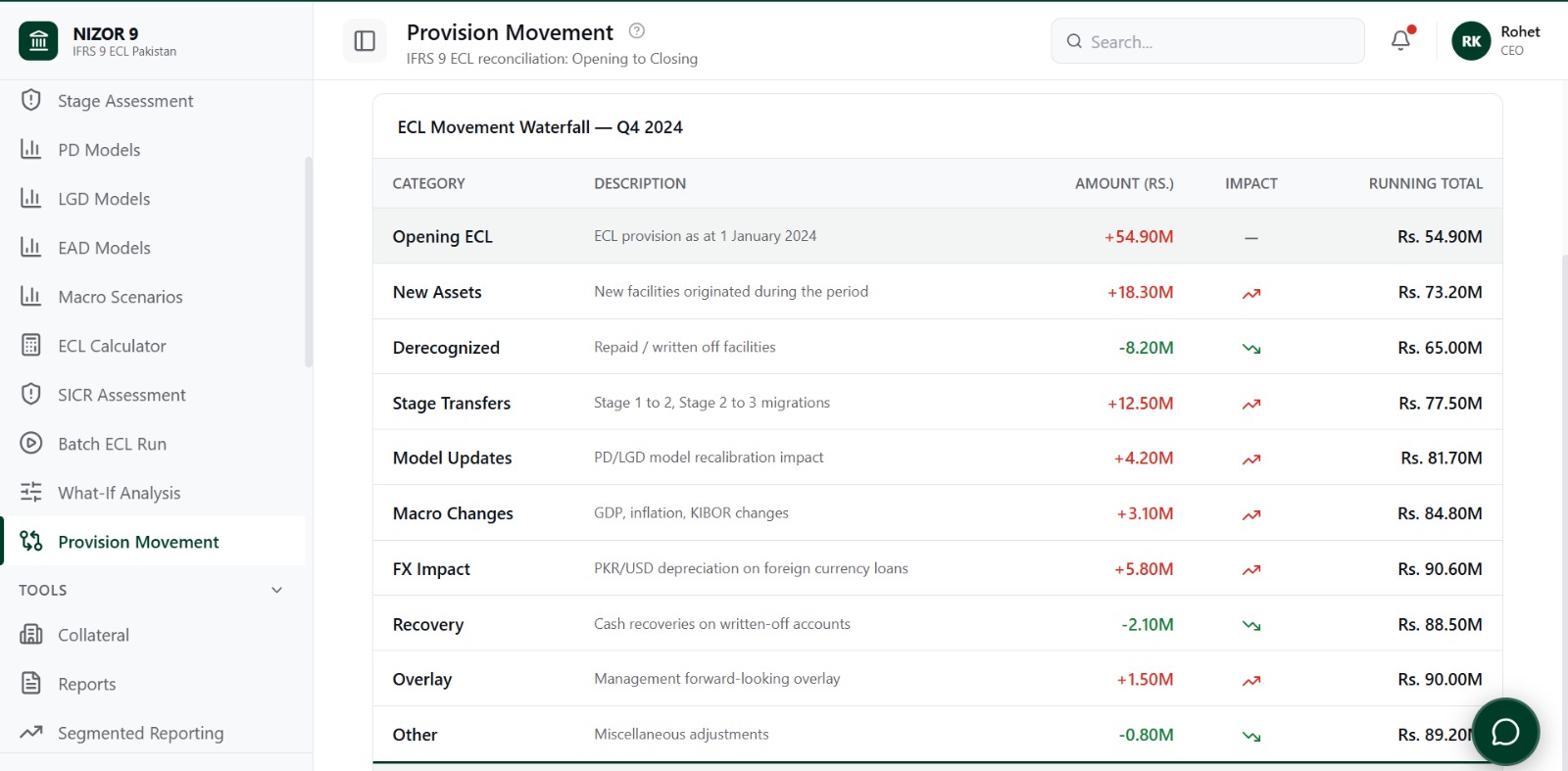
Auditors and regulators want to know why the allowance moved. Nizor 9 builds the ECL movement waterfall automatically, reconciling opening to closing provision across new assets, derecognitions, stage transfers, model recalibrations, macroeconomic changes, FX, recoveries and management overlays. Every line is traceable to the facilities and assumptions behind it.
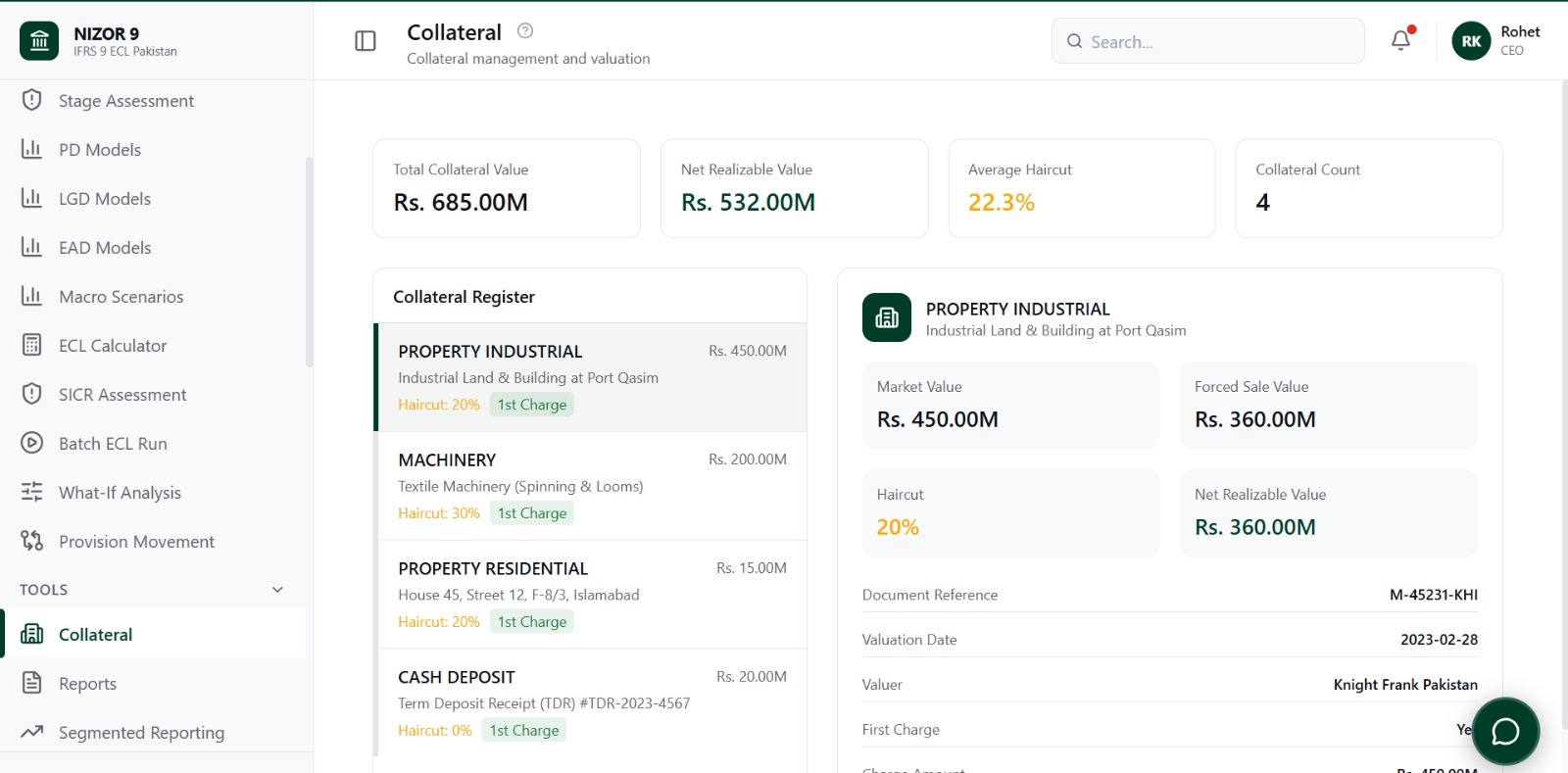
LGD is where recoveries live. Nizor 9 holds a full collateral register, property, machinery, cash and guarantees, with market value, forced-sale value, haircut, charge type and valuation date. Net realisable value flows straight into the LGD, so secured and unsecured exposures are treated correctly and every recovery assumption is documented and dated.
Nizor 9 is built on transparent, documented modelling. Nothing is a black box: every parameter can be traced to its source data, calibration and assumption.
Through-the-cycle PDs are built from multi-year rating migration matrices, then converted to point-in-time and projected under each macro scenario using a documented regression.
Collateral-based and workout LGDs, net of realisable security value and cure rates, segmented by secured and unsecured exposure.
Drawn balances plus a credit conversion factor on undrawn commitments, with amortisation and prepayment behaviour reflected over the horizon.
Quantitative thresholds, the 30-days-past-due presumption and qualitative triggers, with a rebuttable low-credit-risk exemption where appropriate.
Forward-looking variable selection and probability-weighted scenarios, so the allowance reflects the outlook, not just the past.
Management adjustments captured as explicit, documented overlays, visible in the movement and defensible under challenge.
Nizor 9 is designed for the governance, security and auditability that banks and NBFIs operate under, so the platform stands up to model validation, internal audit and the regulator.
Every data load, model run and parameter change is logged with user, timestamp and value, tamper-evident and exportable.
Programmatic portfolio uploads, ECL runs and result retrieval that integrate with your core banking and data warehouse.
Separate modeller, reviewer and approver roles with segregation of duties enforced at the platform level.
Structured returns and disclosure packs, including SBP R-8-style reporting and IFRS 7 credit-risk notes.
Map your portfolio, collateral and historical data with our templates and validator, Finspera 21's IFRS 9 specialists alongside you.
Set staging rules, PD/LGD/EAD parameters, macro variables and scenario weights to your policy.
Reconcile a parallel run against your current numbers and document the methodology for audit.
Run each reporting date at the click of a button, provision, movement, disclosures and returns generated together.
The people who implement the standard built the platform. Advice and tooling come from the same team, so the model matches your policy, not the other way round.
Full methodology documentation, model validation outputs and a complete audit trail are generated automatically, cutting ECL audit cycles and removing spreadsheet risk.
Designed for accountants and credit-risk professionals, not quants. Clear inputs, explainable outputs, and a what-if console that turns sensitivity analysis into a slider.
Request a demo and our team will walk you through staging, modelling and provisioning, using your own data.